Though I lacked a formal term in my lexicon, the concept of “neurodiversity” (though somewhat controversial) is one that I’ve appreciated since long before my own ADHD/LD diagnosis. Typically, neurodiversity is seen as a concept that seeks to portray a variety of neurologically based “disorders” simply as variations—these include ADHD, autism spectrum disorders and Tourette syndrome, as well as specific learning disabilitiesAnother condition under the umbrella is dyspraxia—one that is probably less generally understood than several others on the list. 

I connected with Katherine (whom I always refer to, in my head and out loud, as Kat) several years ago—we connected initially over asthma, but that’s a rarer discussion topic at this point! More often, we’re planning adventures, spending several hours on Skype telling stories, discussing school, or making mug cake (yes, we made mug cake together on Skype—the level of coaching I required was ridiculous, and Kat’s a good person who didn’t make fun of me—too much :).]

Today, Kat is sharing her perspective as an adult with dyspraxia—a developmental delay affecting motor coordination. Dyspraxia is seldom discussed in the context of adulthood, so I’m excited to have Kat here today!

———-

Hello, my name is Katherine and…

I am a computer programmer.

I am learning American Sign Language.

I am a knitter.

I am a book worm.

I am a condo owner.

I am a Cardinals baseball fan.

I am dyspraxic.

My story of life as a grown up is much the same as any other 25 year old female living in the midwestern United States. I do exciting things like go to work, cook dinner, hang out with friends, and explore diverse and varied interests. However, my brain and I occupy a different motor skills space than yours most likely does. In the early/mid 90’s when I was a preschooler/grade schooler I had motor skill developmental delays. At the time the doctors called it dysfunctional/disordered motor planning, at the time new politically correct version of “clumsy child syndrome” which is now commonly know as dyspraxia. Basically my neurons don’t always connect my muscles to my brain well. Sometimes the message gets through and my body works just fine, other times it gets lost along the way. My writing skills are slow, painful, and took exceedingly long to develop. PE was my least favorite class ever; they always passed me but noted a need for improvement of coordination in activities like running, skipping, and jump rope.

In some ways getting to high school, college, and now the “real world” is easier. I’m no longer graded on my penmanship, and no one expects me to write in cursive. Nor does socialization involve jumping double dutch, although walking in heels is equally perilous. The majority of my work and other written communication is keyed out on a qwerty keyboard of some sort. While learning to type was a challenge initially I’ve taken to keying by touch much better than I ever had to writing. You won’t hear many stories like mine because I’m from the US, seemingly few dyspraxics exist Stateside (UK seems to have cornered the market). Also much more common in males for whatever reason. I’m a grown adult who has found a successful contributory place in society.

The voice of adults with developmental delays is seemingly nonexistent. Not because we aren’t here, and no, we didn’t outgrow it. Turning 18, 21 or any other arbitrary age doesn’t magically catch you up to your peers. Some of it is that we’ve learned how to adapt our lifestyles to avoid skills we haven’t mastered. My cooking has never been dinner party elegant but it tastes just dandy. I’ve found cooking implements that don’t require lots of coordination to work (OXO make some real winners at least for me). I drive a stick shift car of the same brand as i first learned on (so it has the same sized gear box with a clutch that “grabs” similarly). If I’m tired or have a mentally stimulating day ahead of me I don’t drive. Quite simply, while I can drive it takes quite a bit of mental concentration to drive, follow the assigned route and otherwise be attentive to my surroundings. Somedays this is more than I should really take on. I know my limits and live close to a transit loop. My life looks like that of the neurotypical adult because pick surroundings and activities that suit my needs and abilities.

Life is learning and growing and changing the world around you to make it work. Taking it in stride when you trip over your own feet stone cold sober in trainers.

—–

Kat has a degree in computer science and works as a programmer—she is pursuing American Sign Language as a personal interest (but in the very ambitious form of evening university classes—and watching the videos for my Disability Studies class in the Fall). Kat’s “diverse and varied interests” include several different fitness pursuits (running, cycling, swimming . . . ahem, triathlon :] . . .), making me jealous as she goes to Chicago, and crafty stuff like knitting and—though, I think this has culminated—having all sorts of condo do-it-yourself shenanigans.  

Kat can be found on Twitter as @kat314159 […yes. That is pi there. No, not that kind of pie].

1002215_10153231634335375_1208441892_n.jpg

Last year, my university changed their graduation requirements for the kinesiology program. This means, since I started the program in 2010 [or something of that nature, I’ve been there too long], I can choose between the new option or the old one. [Main point: the new one requires only anatomy. The old one requires both anatomy AND physiology].  I met with the department chair last year to discuss swapping some previous credits in teaching/psychology related courses for other related ones, and seeing if I could switch anatomy for physiology–just to see if I maybe could handle that better.

Since May, the whole department has kind of switched things up turning into a faculty, however, so I e-mailed the new associate dean on Thursday last week to follow up–turns out that the department chair was taking my request to the curriculum review committee the next day, but we scheduled a meeting anyways. Within 24 hours of his response, I had received an e-mail from the chair as well as a follow-up from the associate dean […got that?].  Approved: Switching coaching/teaching requirement and swapping the psychology class. Not approved: Anatomy exemption/swap. So, I was rather surprised when the associate dean responded with my question of whether we still needed to meet with “I think we should still meet to discuss how you are going to handle the Human Anatomy requirement.”

So what’s changed between last round and this round? Another F, being assessed for learning problems, and becoming registered with Accessibility Services.  I got his reply and my jaw just about dropped.  I walked into his office this morning, and the first thing he said to me was: “Kerri my dear–let’s talk. The department is willing to work with you to get you through anatomy and out of here.”

I was choked up the whole appointment.  The results of that meeting? I couldn’t believe it. At all.

The kinesiology department is not just willing to work with me, they are going beyond what I had ever imagined–much like the accessibility department did. I am floored.

The department is going to pay for a mentor/tutor to work with me. I was prepared to pay for a tutor [and I probably still will for some extra hours]. The number of hours they will cover has yet to be determined, but this is huge. On that note, their hope is that this person is able to work with me in lab . . . in a separate lab section to minimize distraction and ensure I am actually understanding things. This will also allow me to work a bit slower at quizzes in lab and give me a bit more time for the model to sink into my brain.

Second, we discussed testing, specifically in the lab. My accommodations through Accessibility Services already allow me lengthened time for tests [thanks second percentile processing speed!]. We have yet to figure out how we are going to make this work, but it is just awesome knowing that they will make it work. [He offered, also, to exempt me from quizzes and weight my final exams higher, but I decided that it is good to get that kind of progress report on a weekly basis.]

Third–yes, third, and definitely the most interesting–is that the associate dean himself is all over this. He wants me to meet him every few weeks for an hour or two so we can go over what we’ve been working on class–through this, he can figure out the best ways to help me retain what I’m doing in the course, and figure out what I need to work on and help me actually understand it–not just memorize it–and check in regularly about how things are going.

Seriously? Speechless. Honestly, I was told awesome things about this guy. And he not only met my expectations of his awesomeness–he went so far beyond them.

I hope that, with all of the above, I can go far beyond my own expectations, too.

Resistance was a major thing I felt in regard to the last point in the Recommendations section of the report of my psychoeducational evaluation.

It is important to recognize that though an ADHD diagnosis cannot be made based on the results obtained, the possibility of an ADHD diagnosis has not been ruled out. Considering that [Kerri] does exhibit some ADHD traits, she may consider discussing with her physician the possibility of a pharmaceutical intervention to alleviate her ADHD symptoms.

(Wang, p. 8, 2013)

It wasn’t a decision I had to rush into. However, given the realities of the Canadian medical system, I gave myself time to think on it, but talked to my primary care doctor pretty quickly on the subject of medication. I know of a handful of primary care doctors who are comfortable prescribing ADHD meds–mine wasn’t, which I was more than okay with. Instead she told me she could refer me to a psychiatrist–which for me was a much better solution. Because of the inconclusiveness of my “diagnosis”, I wanted to be sure that somebody with actual expertise in these things was working alongside me in the decision process surrounding medication.

That appointment came on Thursday. Wednesday, I didn’t want to go–the resistance returned when I screwed up dosing times for all but one of my asthma meds which resulted in waking up at 4 AM when the Zenhale and Atrovent simultaneously wore off, and forgot my pill at dinner until the next day at lunch. At this point, I had growing resistance to going on yet another medication.  I psyched myself up by reading the treatment chapter from Delivered from Distraction the night before–which helped because it made me realize, unlike my other meds, if I try meds and either a) they don’t help or b) I simply don’t want to be on them . . . I can stop this one. So, I went into the appoitnment a bit more open minded.

Fortunately, the vibe of the appointment was really good, too. I was definitely nervous, which is typical of whenever I see any new doctor, but I had zero idea what to expect from this appointment. I filled out three more pages of assessment questionnaires then waited a long time. Things got better when I walked in to the doctor’s office to neutral colours with the lights off, natural light coming in from the open window, and the doctor’s bike propped up underneath the window. By the time three minutes had passed, she had told me about picking blueberries in her front yard and having “eight thousand mosquito bites”–between that and the bike, I figured things would be good.

After she glossed over my report with a highlighter, we did an hour of story of my life–all the typical intake stuff like I did with assessment. Through that and the new questionnaires she confirmed the ADHD stuff they had uncovered in my original assessment–that I experience significant inattention and impulsivity (but not so much hyperactivity aside from fidgetiness). The impulsivity thing always throws me for a loop–I don’t see myself as particularly impulsive (but maybe that’s part of the problem?). Her final “diagnosis” was that things were still inconclusive, but she was strongly leaning towards ADHD-PI (primarily inattentive).  Story of my life not fitting into boxes (not sure I’d want that any other way :]).

Despite the inability to confirm a diagnosis, she concluded that I do have significant symptoms and medication could be a constructive way of dealing with them. Some discussion, explanation and demonstration with a wicked cool model of a tablet later, I walked out feeling a lot more confident about a lot of things . . . and a super intense looking prescription for Concerta tucked amongst some brochures in my backpack.

Winnipeg-20130808-00258.jpg

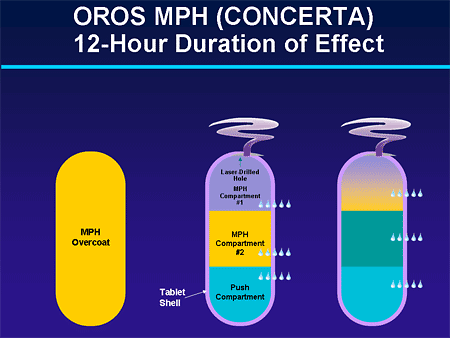
So, I then exchanged super intense prescription for innocent-seeming bottle of controlled substance [which at the time was totally freaking me out haha]. In reality, the extended release meds [like Concerta] are manufactured in a way that they’re basically impossible to snort/inject.

slide043.gif

(Slide 40 – Credit to Medscape)

So, this thing allegedly lasts for 12 hours (which really means from like, 8-14 hours depending on what your body does with it). The outer layer starts working within an hour, then as it hangs out in your stomach, water gets absorbed into the capsule and pushes out the rest of the medication in a controlled-y manner or something. Fancypants. The #1 most well known ADHD med is Ritalin–all Concerta is, is extended release Ritalin (methylphenidate). “Did it on Ritalin, I got me some good grades . . .” / “On a steady diet of / soda pop and Ritalin . . .” / “Cause I’m worth more than this / so stop writing prescriptions for my Ritalin…” [Matthew Good, Green Day and Katy Perry all off the top of my head… there we go!].  Methylphenidate is a stimulant medication–as my doctor explained it, people who have ADHD have brains that don’t know how to “put on the brakes”–stimulate meds “wake up” the part of the brain that helps put those brakes on–focus attention, control impulsivity, and decrease hyperactivity.

DSCF3112.JPG

It’s all a game of playing with dosing. Day one was like magic–I wasn’t fidgety, I had one thought in my head at a time. Day two wasn’t quite as good, but I also didn’t drink as much water throughout the day, so I’m trying to work at that. I’m at the kick-in point on day three now, and mostly I’m trying to keep really close notes on my symptoms and how the meds are working–after three weeks, I can either increase to a 36 mg dose in the morning, or split it in two [the bonus of splitting is that I get longer coverage from the meds–11.5h doesn’t really cover a productive school/work day if I’m studying until like 10 PM or something.

But it’s good. It’s another step that is hopefully in the right direction. It’s another tool that hopefully helps make things better.  Every step, each modification means a bit more work . . . but also hopefully more success, too.

If you’re interested in the day-to-day bits, I’m tweeting on #startingconcerta.

Seven-plus months ago, I started what was an arduous journey. I’d known in myself that something was off for a long time with how I performed educationally. Until university, I didn’t have any exceptional struggles [unless we count that I could never master the multiplication tables, or that even being tutored through grade 9 math I still came out of there with a C]. Then university came. I’m sure I’ve probably dropped nearly as many classes as I’ve taken–I couldn’t get through the readings for the most part [and, let’s be honest, that C in intro psych could have probably been at least a B had I read any of the textbook!]. When anatomy came, I shrugged off the first F–especially after I found out how many people in med school fail anatomy. The second one? I’d put so many hours in. I’d spent countless hours with a tutor, I’d made a stack of flash cards, I’d coloured the colouring book, I wasn’t leaving labs early. I’d failed or near-failed tons of tests, yet by balancing them with papers, I was mostly rolling out C’s and B’s, with a few A’s thrown in in the classes that really gelled with my learning style, my interests, my quirks, and my academic gifts.

When I went through the educational assessment process last Winter, of course there’s all that associated doubt: I’ve gotten this far in school, why am I bothering with this now? They probably won’t even find anything helpful. But, the what-if’s kept me there.  While they were unable to diagnose or exclude ADHD in me, they did nail down a bunch of things: a bunch of things that had lead me to question my abilities at just about everything.

For me, a lot of it lies in my processing speed and working memory. I can’t say I believe in “normal” too much, but in psychology, everything is about deviations from the norm. My processing speed is definitely one of those–it’s only higher than 2% of females in my age group. It also means I’m probably more inattentive and distractible. My working memory deficits makes it more difficult for me to manipulate information in my head. And you know what? That’s nothing that I didn’t already know. It just gave me more knowledge about myself and how to work with what I have.

In the last several years though, I’ve worked with a lot of kids. I’ve worked with a lot of kids whose parents knew something was different and acted on it to help their kids be the best they can be. And I’ve known some kids whose parents chose the other route.  Are their children struggling more than they need to? Are they being denied access to proper supports, both socially and educationally? Is the fear of a diagnosis hindering the child when having more knowledge could be helping?

Diagnosis: it’s not a label, it’s a bridge. Learning about how I learn, about how I have what might be called a learning disability? It’s made all of my struggles make so much more sense. It didn’t start anything new, it just underscored what we know I’ve always excelled in or struggled with. It’s help me maximize on the things I’m good at. It let me know that I’ve struggled for legitimate reasons with a lot of things . . . and I’m not dumb and it’s not my fault.

I have new plans. I have support at school. I have resources that can help me with my outside-of-school life–because that requires a lot of organization that I don’t rock with, too. I have new determination that I can do this.

But I can only imagine how much more settled I would be, how much more successful I’d have been at certain things, if I’d had this knowledge earlier.

My perspective, and this goes especially to parents: if you suspect you or your child may be experiencing specific struggles involving learning, attention, development or socialization. . . do something. Diagnosis of a learning disability, ADHD or a developmental problem is NOT a bad thing. It doesn’t change who you are, it doesn’t change who your child is. It just helps in acquiring the right resources to maximize success, not only academically, but in creating friendships, cultivating creativity, and reducing stress or anxiety.

It doesn’t define me–it helps explain me.

3oqdmi.jpg

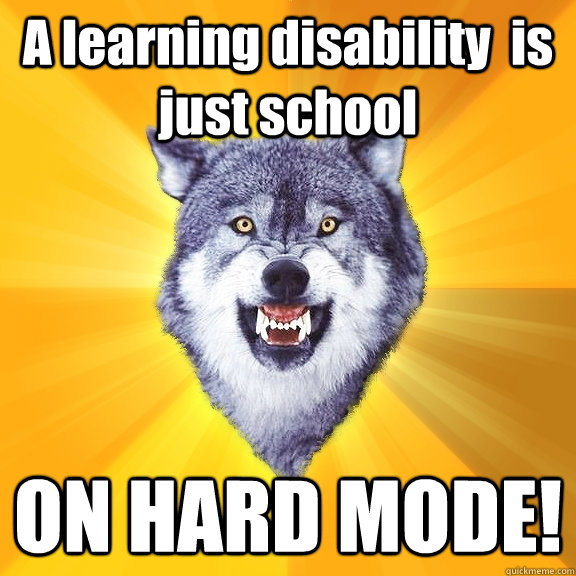
Seriously . . . have to find memes where I can, right?

(source)

I have been almost overwhelmed by the positive words I have gotten from people following the results of my assessment.  I had a few comments that I had to shrug off because, like anything, sometimes people really do not understand–that said, I can’t claim to understand everything either.  However, now that the results and initial meetings are out of the way, it’s about taking the action to modify the process.

This week has been all about seeing that being put into motion. And feeling thankful, grateful for the people around me who are on all sides of making that happen, and helping me to make this transition successful. In reality, it is a continuation of what is going on outside of me, but also a fresh start of what’s going on inside of me. It is knowing that, on the road ahead, that I will have the right things in place. It’s knowing that maybe I might actually have a graduation date in reach. It’s knowing that I can do this, even if I have to do it a bit differently than I have been.

Yesterday I wrote my first exam with accommodations. I used a few minutes of my extra time allowance, and the private room was louder than I thought it would be (so, I will probably take them up on the earplug offer next time. Because that is an available service apparently). I was asked if I wanted a clock or time-prompts during the test (they said it was okay to look at my Fitbit, so I declined). Bonus perks: I got a soft spinny chair and a foot rest. I am not joking people. There were also pencils and an eraser provided on my desk which was unexpected, and I forgot my ID in my jacket pocket which was not with me, and somebody on staff at Accessibility Services [AS] just vouched for me.  (Also everything is really hush and confidential–considering my entire life is on the internet I am not super concerned about this, but it cracked me up when she whispered “What’s your name again?” and I replied at a normal volume.  On the exam-room booking schedule, I was only in there by my initials).  After I finished, I went and hung out outside the room my class was writing in (as they were being held captive for a full class period) to snag my friends Courtney and Rachael after the test to see how it went, and my instructor came and asked how things went.  The test was harder than we thought it would be, and we all didn’t really study the right stuff, but really, it’s Intro to University. It’s fine!

Today I’ve seen things unfolding.

After my instructor left the room in Scientific Principles of Fitness and Conditioning this morning so we could fill out course evaluations, I ran into her as I was leaving the building. “You’re Kerri, right?” [Well, something had to do it. My long standing ability of being another non-descript student to a lot of instructors is coming to an end!] “I was just talking to Accessibility Services about getting the course notes document to you–I’ll send you an e-mail later today.” Sure enough, a few hours later I got a couple of Word documents of the course notes popped into my inbox, cc’ed to my Accessibility Advisor, with an apology for things taking so long. After thanking her (and my advisor who is so fabulous), my instructor then asked me if she needed to provide AS with the final exam for me, following which we had some fun back-and-forth e-mails, which was totally unexpected but, once again, very appreciated.

I also received an e-mail about textbooks for next term from AS, and navigating that audio-conversion process again, and got in touch with my prof for my spring Classics course to see if I could get a syllabus [I need to provide AS with one due to the audio-book thing]. I am only mildly looking forward to this course [see also: lots of reading], but I am now really looking forward to meeting the prof, as she started her e-mail back to me with “Thank you for your beautifully written e-mail.” which totally made me smile. Cracking my shell also involves, of course, self-identifying (I’m getting an official Letter of Introduction for my instructors in upcoming terms, but an informal e-mail is always a good start, too), and making the choice to meet with my profs early on in the term so that I can gauge how best to approach their class and what that process will look like as it unfolds. (This may be the one important tip I took from intro to university!)

I’ve felt grateful. I’ve felt inexpressible appreciation. For all the people in this unexpected journey.  For people who are not only helping these things fall into place, but actually wanting to ensure things happen effectively. For people who are going beyond what they need to, especially at this point in the term, to help me. For people who maybe I have had second thoughts about . . . who are now not only doing what they are required to . . . but going beyond that and helping to meet me where I’m at.

Staring into the intersection, she thinks that she can fly, and she might.

straw dog, something corporate